
Regional impact assessment of air quality improvement: The air quality lifecourse assessment tool (AQ-LAT) for the West Midlands combined authority (WMCA) area

Project lead James Hall
Authors: James Hall a, Jian Zhong b, Sue Jowett a, Andrea Mazzeo b,c,d, G. Neil Thomas c, John R. Bryson e, Steve Dewar f, Nadia Inglis g, Mark Wolstencroft h, Catherine Muller b, William James Bloss b, Roy M. Harrison b,i, Suzanne E. Bartington
a Health Economics Unit, Institute of Applied Health Research, University of Birmingham, Edgbaston Park Road, Birmingham, B15 2TT, UK
b School of Geography, Earth and Environmental Sciences, University of Birmingham, Edgbaston Park Road, Birmingham, B15 2TT, UK
c Institute of Applied Health Research, University of Birmingham, Edgbaston Park Road, Birmingham, B15 2TT, UK
d Lancaster Environment Centre (LEC), Lancaster University, Bailrigg Campus, Lancaster LA1 4YW, UK
e Department of Strategy and International Business, Birmingham Business School, University of Birmingham, Edgbaston, Birmingham, B15 2TT, UK
f Coventry City Council, Earl Street, Coventry, CV1 5RR, UK
g Walsall Council, Civic Centre, Darwall Street, Walsall, WS1 1TP, UK
h Birmingham City Council, Victoria Square, Birmingham, B1 1BB, UK
i Department of Environmental Sciences, Faculty of Meteorology, Environment and Arid Land Agriculture, King Abdulaziz University, Jeddah, Saudi Arabia
Quick Summary
This study looked at how air pollution is harming people’s health in the West Midlands, including Sandwell. It found that air pollution is linked to thousands of illnesses and more than 2,000 deaths each year in the region. The researchers created a tool to show what would happen if the air was cleaner. They found that meeting World Health Organization air quality limits could save thousands of lives, prevent many cases of asthma, heart disease, stroke and lung cancer, and save billions of pounds over 20 years. The study shows that cleaner air would mean healthier people, less pressure on the NHS, economic and equality benefits, and big benefits for places like Sandwell.
Objectives
- Create a simple tool that local councils can use to measure the health impact of air pollution.
- Estimate how many illnesses and deaths are linked to air pollution.
- Work out how much air pollution costs the NHS and wider society.
- Predict how many lives and illnesses could be saved if air pollution meets World Health Organization guidelines.
- Help local authorities make better decisions about clean air policies.
Why is this research important?
Air pollution is the biggest environmental risk to health in England. In the West Midlands, around 2.9 million people are affected. On average, air pollution can shorten life by up to six months.
This study explains a new tool called the Air Quality Lifecourse Assessment Tool (AQ-LAT). The researchers created a computer tool to estimate how air pollution affects health over time. The model focused on long-term health problems and used careful, conservative estimates, meaning the real impact of air pollution may actually be higher.
It was made to help local councils understand:
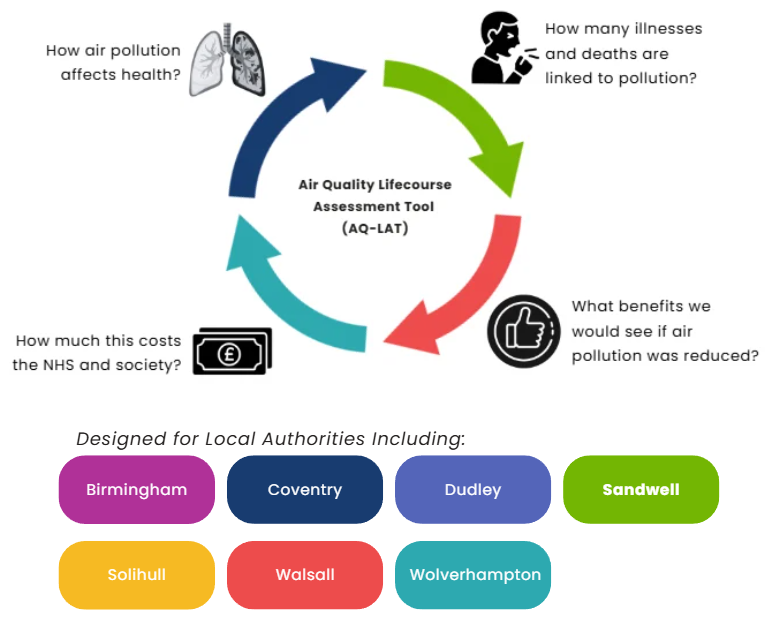
Air Quality Lifecourse Assessment Tool (AQ-LAT)
Why is this tool important?
The AQ-LAT tool:
- Uses detailed local data (down to ward level)
- Helps councils see which areas are most affected
- Supports planning and investment decisions
- Shows how improving air quality can reduce health inequalities
It has already helped shape air quality planning in the West Midlands.
Findings
What pollutants were studied?
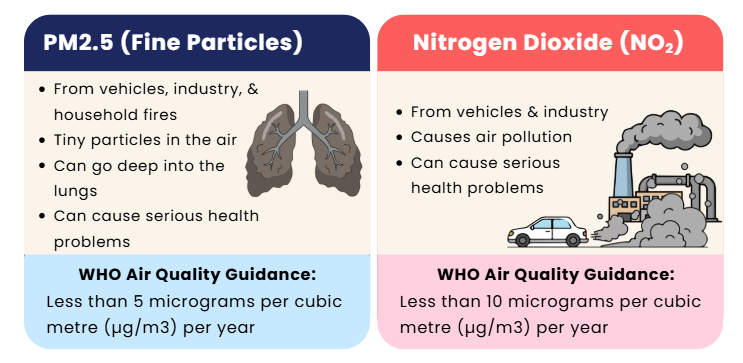
Pollutants in the air
The World Health Organization (WHO) says these pollutants should be kept very low. However, everyone in the West Midlands lives in areas above these WHO limits.
What is happening now?
In one year in the West Midlands, air pollution was linked to 2,068 deaths, 2,000 new cases of asthma, and hundreds of new cases of heart disease, stroke and lung cancer (based on 2019 data). These are serious long-term health problems
The impact is not equal across the region. Areas with higher population and deprivation — including parts of Sandwell and Birmingham — have some of the highest health burdens from air pollution.
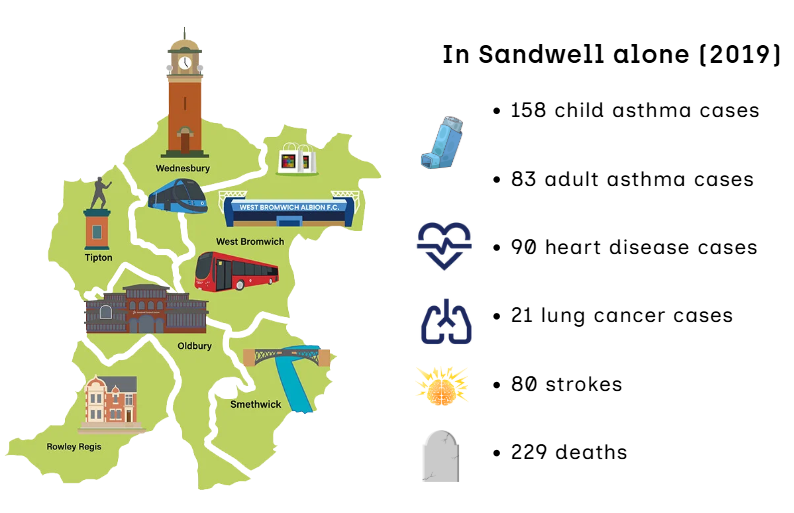
Sandwell statistics for air pollutant related health problems
What if air pollution met WHO guidelines?
The researchers modelled what would happen over 20 years if pollution levels were reduced to WHO standards. Across the West Midlands, this could lead to:
- 10,700 fewer deaths
- 20,500 fewer asthma cases
- 7,400 fewer heart disease cases
- 5,700 fewer strokes
- 1,400 fewer lung cancer cases
This would reduce overall deaths in the region by about 1.8%.
What about costs and savings?
Reducing air pollution would also save money. Across the West Midlands over 20 years:
- £285 million saved for the NHS
- £167 million saved in social care
- £175 million saved from fewer days off work
- Around £3.2 billion total economic benefit
About 30% of the health benefit comes from people living with fewer illnesses (better quality of life), not just from preventing deaths.
Benefits for Sandwell
Sandwell has one of the highest health burdens from air pollution in the region. This means action to improve air quality could bring especially large health and economic benefits for local people.
What cleaner air could mean (over 20 years)
If air pollution in Sandwell was reduced to meet World Health Organization guidelines, the area could see:
- 2,456 fewer asthma cases
- 920 fewer heart disease cases
- 736 fewer strokes
- 181 fewer lung cancer cases
- 1,336 fewer deaths
This would mean thousands of Sandwell residents living longer and healthier lives.
Financial and wider benefits
Cleaner air in Sandwell would also:
- Reduce pressure on local NHS services
- Lower social care costs
- Reduce time off work due to illness
- Improve quality of life for many families
Because Sandwell has higher levels of deprivation and existing health inequalities, improving air quality could help reduce health gaps between communities.
To learn more please contact: