
Inequality in the access to Maternal Mental Health Services
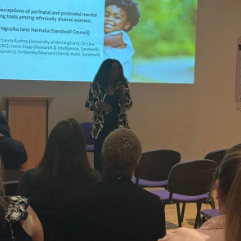
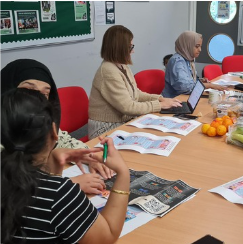
Project lead Dr. Jane Hemuka (left) and one of the focus groups (right)
Aim
The study wants to find out what pregnant women and new mothers who don’t speak English as their first language think about the tools used to check for mental health problems during pregnancy and after birth.
Objectives
- Gather women’s experiences of current mental health screening tools.
- Learn what women think about how well these screening tools work.
- Find out why new and soon-to-be mothers from non-English speaking communities may struggle to use these tools.
- Make recommendations to help policymakers and health workers fix the problem.
Why is this research important?
Mental health problems like depression and anxiety affect about 10–20% of women who use maternity services in the UK. A 2024 report called MBRRACE-UK found that 34% of deaths between 6 weeks and 1 year after pregnancy were linked to mental health problems (Felker et al., 2024).
The National Institute for Health and Care Excellence (NICE) says women should be checked for depression and anxiety at their first GP or booking appointment in pregnancy, and again after birth.
Different ethnic groups do not always get the same care for depression during or after pregnancy. A study showed that South Asian, Black, and “White other” women in England are less likely to use perinatal mental health services than White British women, even though they often feel the same, or greater, levels of distress (Jankovic et al., 2022; Conneely et al., 2023).
What we did, With Who and How
Phase 1: Co-production activity - A wellbeing event at a Family Hub (Barnardo’s in Smethwick) where the public could help shape the study and give feedback on the topic, methods, and questions.
Phase 2: Interviews and group discussions with women from non-English-speaking communities.
Phase 3: Sharing the findings, showing the impact, and planning how to spread the knowledge:
- Community events with interview groups and PPIE members to check and share findings and recommendations.
- Setting up a peer support network
- Community activities
- Online talks (Webinars)
- Written reports and articles
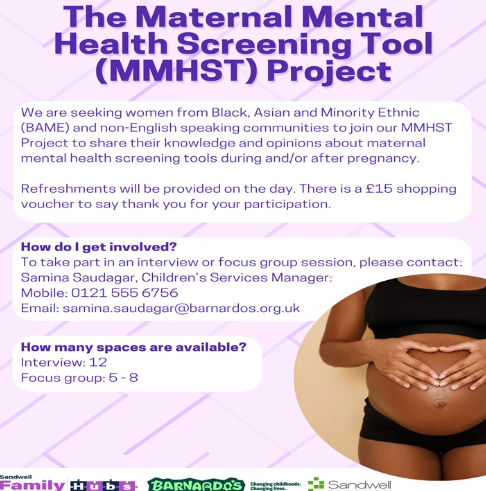
Advert poster for the focus groups
Findings
A total of 15 local women took part in the study. Most of the women were of Indian background, living in Smethwick, and aged between 25 and 34 years. The rest came from a mix of African, Bangladeshi, Pakistani, Caribbean, and Afghan communities.
The study found several key themes:
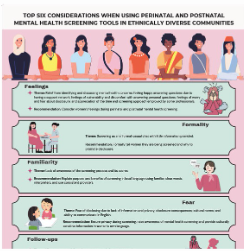
- Feelings - Women felt better when they could share worries and happy when family gave support, but some also felt scared or uncomfortable with personal questions. Some liked when professionals took time and were caring
- Formality – Screenings often felt like informal conversations rather than structured assessments. Many women did not realise they were being screened for mental health, seeing it more as a casual chat about feelings and family support.
- Familiarity – Some did not understand how screening worked or what scores meant. Certain words, such as “edge” in the GAD-7, were hard to understand or translate, leading to loss of meaning across languages.
- Fear – Women worried about what would happen if they shared too much, especially with little privacy, language barriers, or cultural pressures. Questions about self-harm caused particular concern.
- Follow-ups – Many women reported no follow-up or ongoing support after screening, leaving needs unmet and limiting the benefits of initial conversations.
- Focus – Better experiences came when professionals gave enough time, showed real interest, and built personal connections. This made women feel listened to and supported.
Recommendations to Improve Mental Health Screening
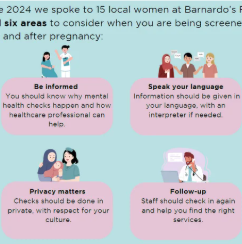
- Think about women’s feelings, raise awareness, and give clear information about mental health checks, especially for underserved and immigrant groups.
- Use local languages, clear words, and interpreters if needed; involve women in discussions and explain available services.
- Make sure privacy is respected, give culturally sensitive information, and have more staff from different ethnic backgrounds to build trust.
- Check in with women after screening, refer them to services when needed, and support them in getting help.
- Give enough time for person-centred care, be consistent, show real interest in the mother, and encourage peer support groups.
Skills Development
- Team members helped with planning, running, and carrying out interviews and group discussions.
- The team worked with local residents (including Barnardo’s staff) as Public and Patient Involvement and Engagement (PPIE) members. They helped shape the research design, data collection, and results.
- By creating a postcard to share knowledge, staff learned how important co-production is and how to make outputs that suit different audiences.
Benefits for Sandwell
For Sandwell residents, the study offered:
- A space to share personal experiences of being screened.
- A chance to teach healthcare staff about key things to think about when screening women from non-English speaking backgrounds.
- A chance to help create a postcard for sharing knowledge.
- This work raises awareness about the issues affecting maternal mental health and calls for action from health and care services.
For health professionals:
- The findings were shared with health visitors at the Quality, Improvement, Health and Delivery (QIHD) meeting in Oldbury.
- They were also shared with the community midwives’ forum in Sandwell.
- This work led to a set of policy recommendations, which can be found in the full report.
- Overall, the project has helped staff build their skills and made sure local residents’ voices were heard and valued in shaping future practice.
Research Outcomes
- Screening tools are generally accepted and seen as effective by women from non-English speaking backgrounds.
- Effectiveness improves with better follow-up, referrals, and privacy during appointments.
- Clear information on purpose and outcomes can increase engagement and support better mental health.
To learn more or access this study in another language please contact:
Family_HubsTeam@sandwell.gov.uk
Or visit: